Hierarchy of Noise Control
Under the Control of Noise at Work Regulations 2005, employers are legally required to reduce workplace noise exposure to as low as reasonably practicable. Just carrying out a risk assessment is not sufficient to meet the requirements of the regulations - noise must be controlled.
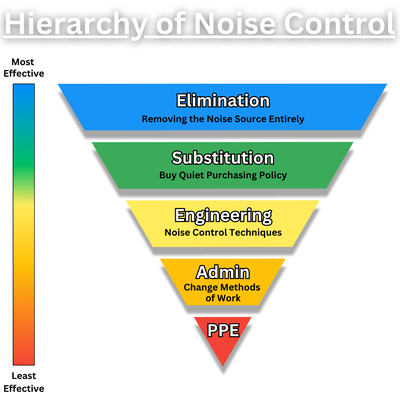
To minimise the risk of hearing to your employees and meet your regulatory duty, the hierarchy of controls must be followed:
- Elimination: Remove hazardous noise sources entirely. This is the most effective measure, but is not usually practical.
- Substitution: Implement a 'Buy Quiet' purchasing policy - i.e. when purchasing equipment, consider low noise options.
- Engineering: Introduce noise control measures. This should prioritise tackling noise at source through engineering means.
- Administrative Controls: Change working methods to reduce the time exposed to hazardous noise.
- PPE: Provide a selection of hearing protection to those who continue to be at risk. Hearing protection is the least effective control measure and should only be used as a last resort when all other options have been exhausted.
Our Approach
Our mindset when we look at workplace noise is to determine the most practical and effective way to reduce noise risk within the workplace. A typical occupational noise control project would involve:
By accurately diagnosing the cause of the noise first, it is often possible to reduce the risk of noise induced hearing loss by 50 - 90% using source engineering techniques. These techniques can usually be implemented at substantially lower cost than traditional noise control methods.
Keep current with occupational noise
Subscribe for the latest in techniques and best practice
