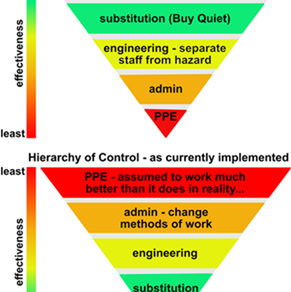
Sad fact: the general standard of hearing damage risk reduction advice is abysmal. Consequently, many people continue to suffer unnecessary hearing damage. Discuss...
The general standard of noise risk mitigation reporting is truly awful. The Environment Agency recently published the results of a survey of the quality of reports from noise consultants, 95% of which were deemed inadequate (60% were deemed extremely poor). A past HSE survey of occupational noise risk mitigation reporting produced similar results.
As the noise consultancy industry is predicated on measurement, virtually the only risk mitigation measure ever recommended is based on PPE. The Hierarchy of Control (HoC) requirement that noise control should be the priority requirement is ignored.
Consequently, organisations currently waste resources on measures that are not cost-effective, are not best practice, and do not adequately protect against Noise Induced Hearing Loss ( NIHL).
Noise Control Audit: the cost-benefit analysis method
The following are the steps involved to generate an accurate cost-benefit analysis of the noise control options. Each step generates the information required to evaluate and cost the options to compare with the costs and efficacy of a continuing PPE programme. Organisations will often find that the recommended noise control programme will:-
- provide a higher risk reduction than PPE based programmes
- pay for itself within 1 - 5 years, making it the self-financing and profitable option
